|
Research Article
Gastric residual volumes and gastric ultrasound in young children fed with breast milk 3 hours prior to general anesthesia: A prospective observational study
1 Anaesthetic Department, King’s College Hospital (KCH), Denmark Hill, London SE5 9RS, UK
2 Anaesthetic Department, King’s College Hospital (KCH), Denmark Hill, London SE5 9RS, UK
3 Anaesthetic Department, King’s College Hospital (KCH), Denmark Hill, London SE5 9RS, UK
4 Anaesthetic Department, King’s College Hospital (KCH), Denmark Hill, London SE5 9RS, UK
5 Anaesthetic Department, King’s College Hospital (KCH), Denmark Hill, London SE5 9RS, UK
6 Anaesthetic Department, Birmingham Women and Children’s (BWC) Hospital, Birmingham B15 2TG, UK
7 Anaesthetic Department, King’s College Hospital (KCH), Denmark Hill, London SE5 9RS, UK
8 Anaesthetic Department, Birmingham Women and Children’s (BWC) Hospital, Birmingham B15 2TG, UK
9 Anaesthetic Department, King’s College Hospital (KCH), Denmark Hill, London SE5 9RS, UK
10 Anaesthetic Department, King’s College Hospital (KCH), Denmark Hill, London SE5 9RS, UK
Address correspondence to:
Dominic Nielsen
Anaesthetic Department, King’s College Hospital, Denmark Hill, London SE5 9RS,
UK
Message to Corresponding Author
Article ID: 100022A05ES2025
Access full text article on other devices

Access PDF of article on other devices


How to cite this article
Saffer E, Day S, Dukoff-Gordon A, Henderson D, Wing JLK, Rook W, Seddon DR, Stendall C, Ward C, Nielsen D. Gastric residual volumes and gastric ultrasound in young children fed with breast milk 3 hours prior to general anesthesia: A prospective observational study. Edorium J Anesth 2025;8(2):1–8.ABSTRACT
Aims: The volume of gastric contents that might be expected at anesthetic induction following a 3-hour breast milk fast has not yet been investigated. The role of gastric ultrasound in quantifying particulate gastric content is also undefined. The primary objective of this study is to assess the gastric residual volume (GRV) measured by gastric suctioning in children who are breast fed 3 hours prior to general anesthesia. The secondary objective is to compare measured and predicted GRV, using a published formula derived from a gastric ultrasound study in infants.
Method: An observational prospective study of children aged 37 weeks to 18 months, fed 3 hours prior to general anesthesia was performed at 2 tertiary pediatric centers. Assessment of gastric antrum was performed using gastric ultrasound. The correlation between predicted and measured gastric residual volume was investigated using Pearson’s correlation coefficient.
Results: Data from 44 general anesthetics performed in 42 children, with a median age of 9.5 months, and a median fasting time of 180 minutes are reported (range 150–210 minutes). Median GRV was 0 mL kg−1 (IQR 0–0.1). Correlation between predicted and actual gastric residual volume by aspiration was weak (r = 0.42, p = 0.007).
Conclusion: For breast milk fasting intervals of 3 hours, GRV was low and comparable to an overnight fast in this small study. The limited feasibility of performing awake gastric ultrasound in this age group, and therefore limitations as a clinical tool are discussed.
Keywords: Anesthesia, Breastfed, Fasting, Gastric
INTRODUCTION
Prolonged fasting prior to general anesthesia (GA) is common in children. It is associated with dehydration, hypoglycemia, and ketoacidosis in up to 28% of children under three years, as well as distress in children and their families [1],[2],[3]. The European Society of Anaesthesia and Intensive Care published guidance in 2022, advocating a 3-hour breast milk fast in children undergoing elective GA [4]. This guidance is based largely on studies in neonatal intensive care using serial gastric ultrasound (US) measurements of antral cross-sectional area (ACSA) over time following a feed, with return to pre-feed baseline reported within 3 hours [5],[6] [7],[8].
There is minimal data on direct measurement of GRV in well children presenting for elective surgery, 3 hours following a breast feed. Quantifying GRV is important as pulmonary aspiration of particulate matter, for example, curdled milk, in animal models causes significant morbidity at much lower volumes (0.8 mL kg−1) than aspiration of clear fluid, where larger volumes may be tolerated [9],[10],[11],[12].
Gastric ultrasound
Perlas et al. devised a qualitative assessment grading system using data from adult elective surgical patients, [12], with a view to guiding decision making regarding the induction method. Various formulae that incorporate antrum grade and ACSA have subsequently been devised and validated in adults and children over one year of age [13],[14].
A formula derived by Kim et al. correlates predicted GRV to suctioned gastric fluid volumes in anesthetized children under one year of age [15]: In their study, 192 formula/breast-fed infants were anesthetized following an 8 hour fast. Gastric residual volume was measured by gastric suctioning via NG tube. Ultrasound scan (USS) measurements were taken in the supine and right lateral decubitus (RLD) positions. Multiple regression analysis using values for supine ACSA, RLD ACSA, and antral grade identified all 3 as independent predictors for suctioned GRV.
Aims and objectives
The primary aim of this study was to measure GRV of gastric contents measured by gastric suctioning in children who were breastfed 3 hours prior to general anesthesia.
The secondary aims of this study were to correlate predicted GRV using the formula proposed by Kim et al., to measured GRV by gastric suctioning.
MATERIALS AND METHODS
The study was registered on Clinical trials.gov (ID NCT05355428) and a favorable opinion obtained on 2nd August 2022 from the Research Ethics Committee (West Midlands–Solihull, ref 22/WM/0161).
A prospective observational study of children aged 37 weeks post-menstrual age (defined as the sum of gestational age plus postnatal age) to 18 months undergoing elective surgery at Kings College Hospital and Birmingham Women and Children’s Hospital was performed. Children with significant cardiac, pulmonary, or neurological comorbidities, or those suspected/proven delayed gastric emptying were excluded. Full list of exclusion and inclusion criteria available on request. Eligible children were identified from theatre scheduling and magnetic resonance imaging/computed tomography (MRI/CT) lists, 1 to 2 weeks prior to procedure date. Parents were contacted prior to the procedure date for screening. Written informed consent was obtained from the parents prior to enrolment.
Procedural details
Children were fed as close as possible to 3 hours prior to the induction of GA, using scheduled procedure start times. Children who were anesthetized more than 3.5 hours, or less than 2.5 hours after the end of their breast milk feed were excluded. Parents were asked to follow standard UK practice for clear fluid and formula/solid food fasting (1 and 6 hour fasts respectively). Times of breast milk feed, and any other feeds such as solids, formula milk and water/dioralyte, were recorded.
Children were scanned using the Sonosite SII and a 13–6 MHz linear transducer (HFL38xi) just prior to or following induction of anesthesia in the supine and RLD positions while breathing spontaneously. If a child became very distressed during the awake scan, the scan was deferred until the patient had been anesthetized and IV access was secured, but prior to the commencement of positive pressure ventilation or instrumentation of the airway. Fasting time was calculated as interval from end of breast milk feed time to start of gastric USS time (if awake) or the anesthetic induction time (if USS performed asleep). When scans were completed awake, if the formula calculated a GRV > 0/8 mL kg−1, the anesthetic induction would be deferred by 60 minutes. If a child who had a fasting time of less than 180 minutes and became distressed during scanning, the study investigator would perform a limited awake scan to confirm the antrum was empty prior to induction (grade 0).
Antral cross-sectional area measurements were obtained in each position using the Sonosite inbuilt software to calculate ACSA from the free traced circumference around the gastric serosa, following the outer border of the hypoechoic gastric muscularis layer, as previously described in the literature [16]. The antrum was graded as 0, 1, or 2, using the method described by Perlas et al. The predicted GRV was calculated using the following formula:
Predicted volume (mL) = −3.7 + 6.5 × [right lateral decubitus ACSA (cm2)] − 3.9 [supine ACSA (cm2)] + 1.7 × grade
Nasal or oro-gastric aspiration was performed using a stiff, multi-orifice 10 Fr polyurethane NG tube in the right lateral, left lateral, and supine positions, and the volume was recorded. The tube was inserted following endotracheal intubation, or prior to placement of the supraglottic airway. Neither the attending anesthetist nor the study investigator was blinded to the fasting time or US findings.
Adverse events (AE) were recorded up to 24 hours after the procedure or until discharge for the day-case procedures, via in-person review or reporting direct from the attending anesthetist, and review of the electronic patient record. Parents were kept informed of any relevant events or findings occurring from admission to the ward through discharge home that were felt to be relevant to the study.
Statistical methods
A data analysis and statistical plan was written and posted on a publicly accessible server before data were accessed. Based on studies reporting serial gastric US measurements in NICU, where ACSA measurements return to baseline (pre feed) by 3 hours, authors anticipated that GRV would be low and comparable to that measured in the study by Kim et al. (mean GRV of 0 mL kg−1). A previous study by the same authors investigating GRV in children following a 1-hour clear fluid fast with oral paracetamol syrup identified a SD of 0.76 mL kg−1 [17]. Similar SD values were reported in the study by Schmidt et al. [18] after a 60-minute clear fluid fast (0.63 mL kg−1). We aimed to design a study to estimate the mean to within a 0.2 mL kg−1 margin of error for GRV.
The following formula was used to calculate the sample size
n = ((Zα/2σ)2E2)
(Where n = required sample size, Zα/2 = Z-score for the desired confidence level, σ = assumed standard deviation, E = assumed margin of error). For this study, we take α= 0.05, σ = 0.63, and E = 0.2 as the desired precision to give a required sample size of 30.1 participants.
To correlate predicted and measured GRV using Pearson’s coefficient with a significance level of 0.05, statistical power of 80% and expected correlation r of 0.5 (moderate-to-strong), the required sample size was calculated using Fisher’s Z-transformation for correlation at 30 participants.
Participant characteristics were summarized descriptively using means (standard deviation), median (inter-quartile range), or number (percentage), where appropriate. For categorical variables, Chi-squared or Fisher’s exact tests were used to test if there are differences in between groups as appropriate. Continuous variables were first assessed for normality using Shapiro–Wilko tests before using the two-sample t-test or Mann–Whitney U test as appropriate to test for differences in mean (outcome) between which groups.
RESULTS
Recruitment began in September 2022 at Kings College Hospital (KCH), London, and Birmingham Women and Children’s Hospital (BWCH) in January 2024. Recruitment was completed at both sites by July 2024.
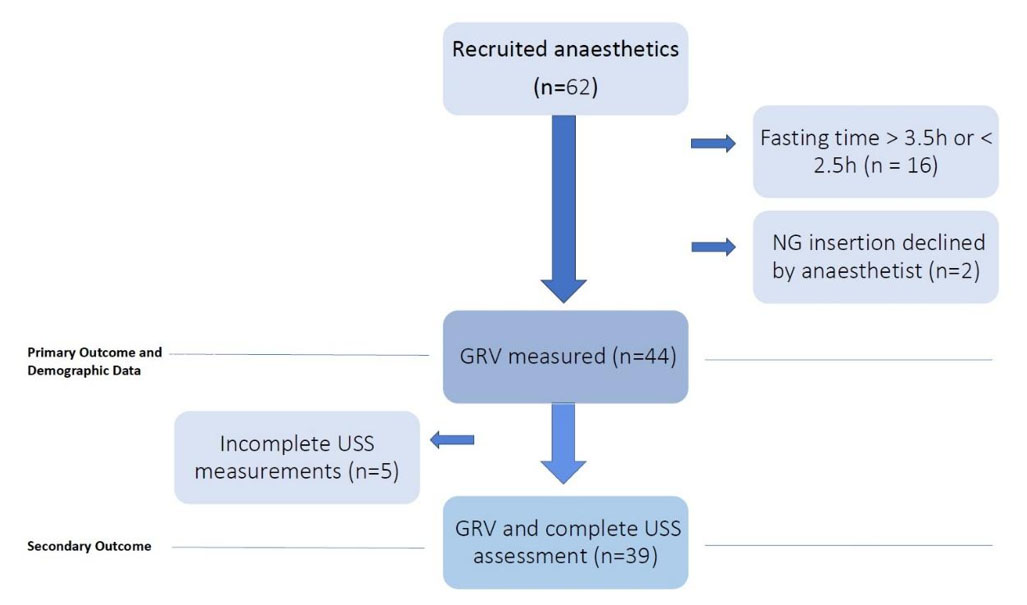
Data for 62 general anesthetics administered to 60 children were recorded. Data from 16 anesthetic events were subsequently excluded because of a fasting time over 3.5 hours, or under 2.5 hours, and 2 hours where NG insertion was declined by the attending anesthetist (Figure 1).
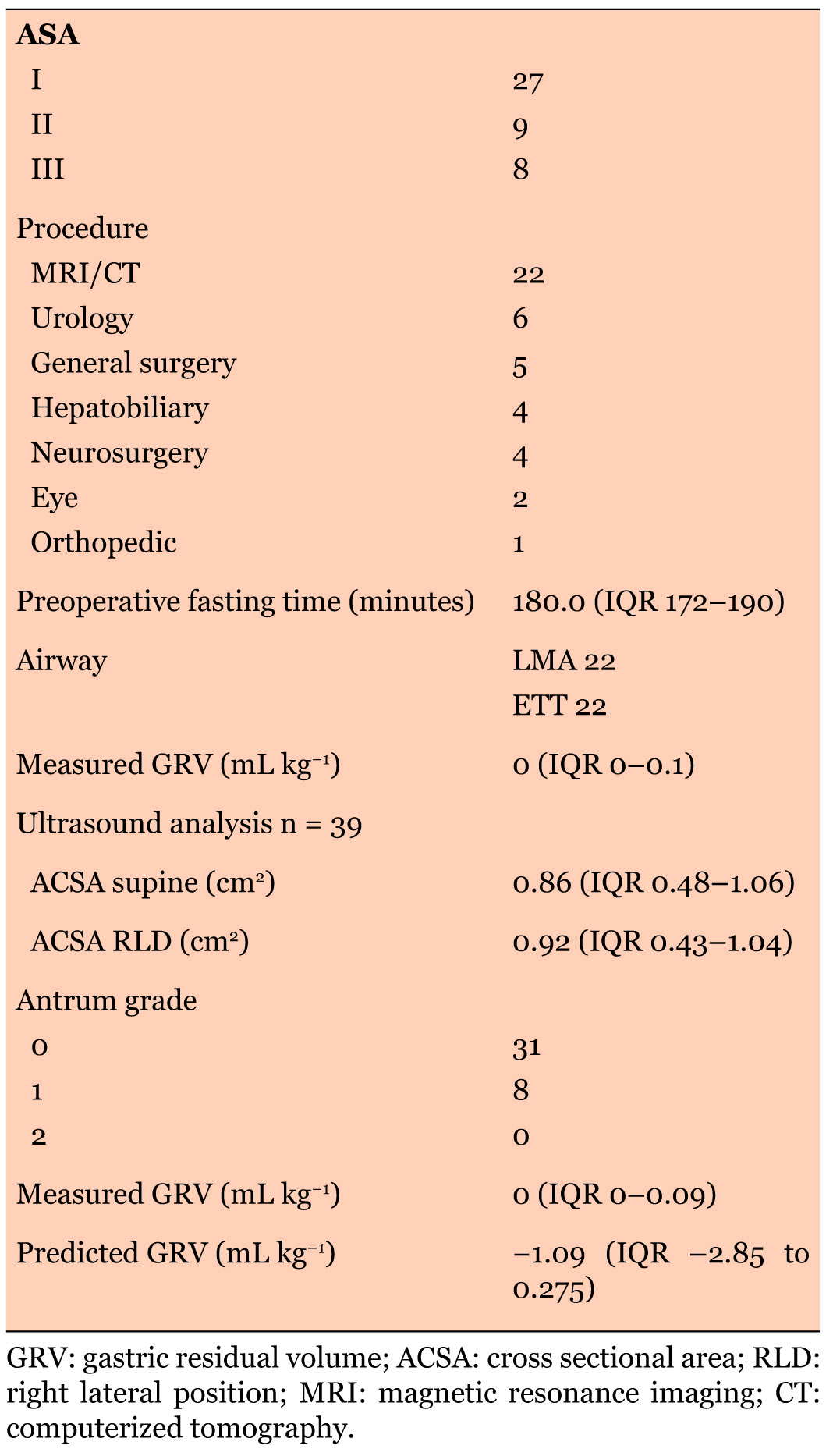
Patient demographics and results for the remaining 44 anesthetics (42 children) are summarized in Table 1. 32 children were recruited from King’s College Hospital from Sept 2022 to June 2024. Two children were each recruited twice more than 28 days apart. 10 children were recruited from BWC (Jan–July 2024). The median GRV in children fasted from 2.5–3.5 hours was 0 mL kg1 (IQR 0–0.1 mL kg−1).
Ultrasound analysis
Complete US analyses in the RLD and supine positions were performed in 39 anesthetics; Reasons for incomplete US analysis included air artefact in colon or stomach (n = 2), unavailability of equipment (n = 2), or request by attending anesthetist to abandon due to time or stressful induction (n = 1). In only 8/39 cases, complete US studies could be performed awake. This was due to excessive movement or distress in the child during the examination. In all 8, predicted GRV was less than 0.8 mL kg−1.
Table 1 summarizes the qualitative and quantitative USS data.
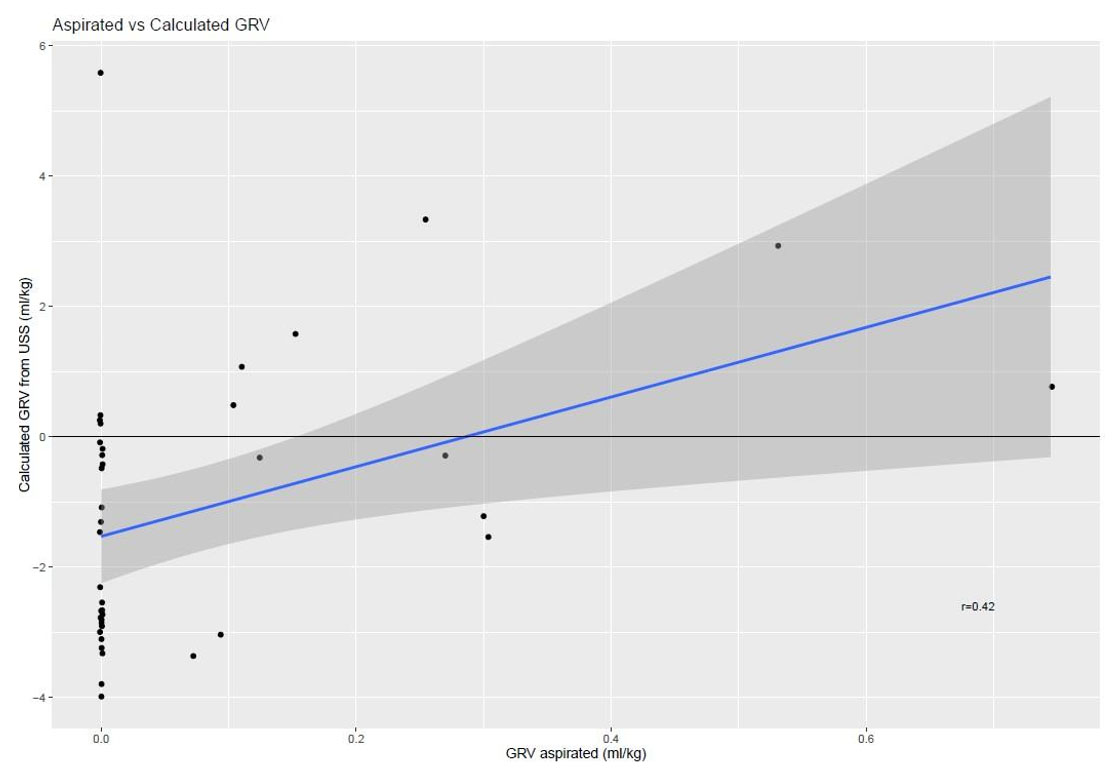
There was weak correlation between calculated GRV using the Kim formula and the aspirated GRV for the 39 cases where ACSA and GRV data were measured [r = 0.42, p = 0.007 (Figure 2)]. The formula predicted a negative value for GRV in 29 cases. There was no significant correlation between RLD ACSA and aspirated GRV (r = 0.22, 95% CI −0.09 to 0.49, p = 0.15).
Antrum grading
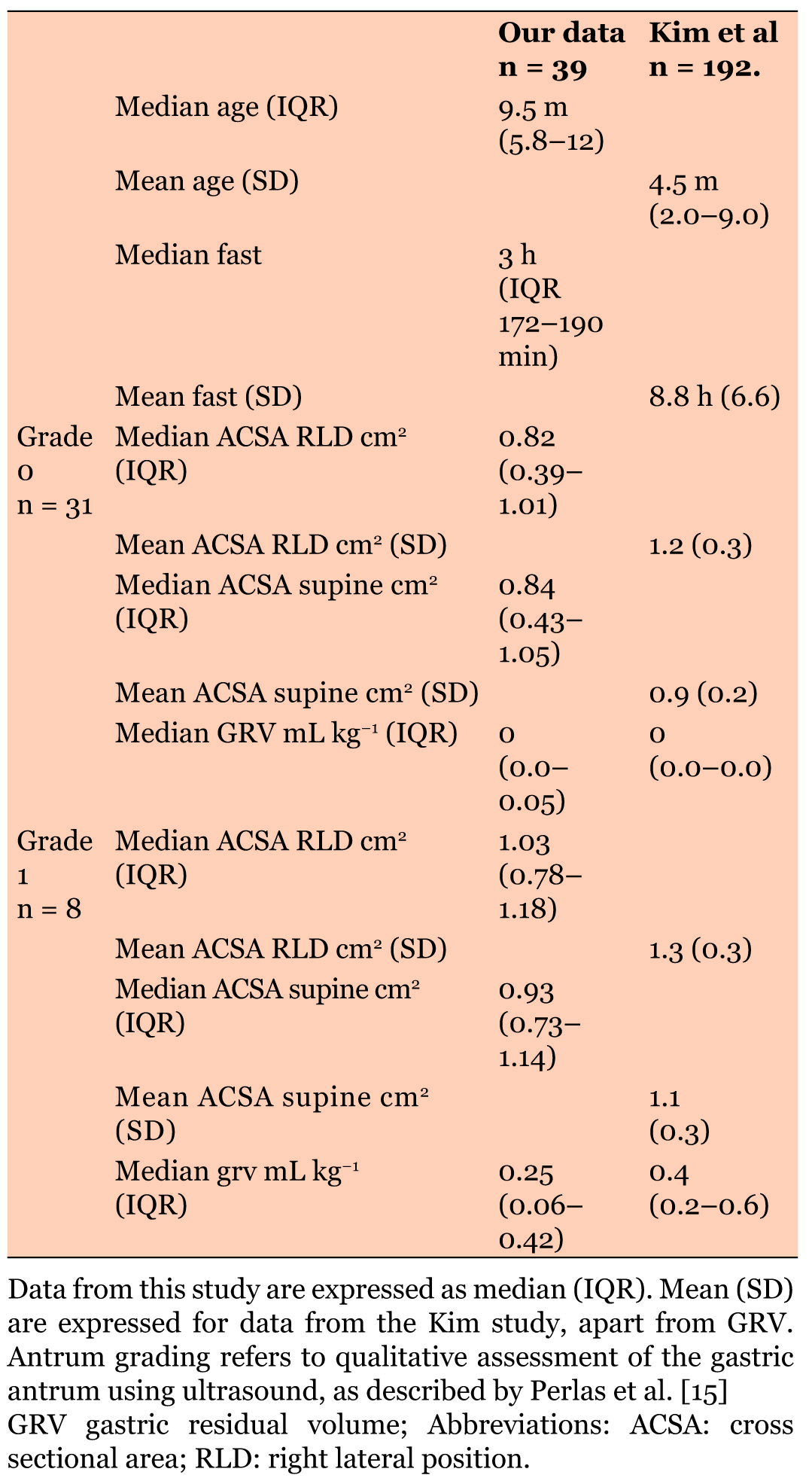
Table 2 summarizes the differences in GRV and supine/RLD ACSA for each grade of the antrum between our study and those of Kim et al. [19]. In 31 anesthetics, the antrum grading given by the study investigator was 0 (no visible gastric content in RLD and supine positions) and median GRV in this subgroup was 0 mL kg1. In 9/31 grade 0 antrums, there was some gastric content on suctioning, with a maximum GRV of 0.3 mL kg−1.
In 7 GAs, a grading of 1 was assigned. The median GRV in grade 1 antrums was 0.27 mL kg−1, with a maximum of 0.74 mL kg−1. No antrums were grade 2 on gastric US.
For antral grades 0 vs 1 the difference in aspirated GRV was –0.25 mL kg−1 (95% CI –0.53 to -0.11), p = 0.003 (Wilcoxon rank sum test).
Adverse events
No episodes of gastric aspiration were detected. Four recorded adverse events occurred in 62 general anesthetics; one child (aged 2 months PMA) had a desaturation secondary to dislodged endotracheal tube during OG placement. The patient briefly desaturated (lowest 70%) and was reintubated with immediate resolution of hypoxia. The surgery proceeded as planned, and no further untoward events occurred. Three children had laryngospasm requiring application of positive end-expiratory pressure to resolve: a 14-month old for MRI on gas induction and insertion of LMA, a 7-month-old hernia repair on deep extubation, and a 13-month excision of periauricular skin tag on gas induction with no sequelae (such as oxygen requirement in recovery or admission from day surgery).
DISCUSSION
Although pulmonary aspiration events are rare in children[16],[19],[20], data from animal models suggest that the volume and presence of particulate matter, such as that seen in acidified breast or formula milk, can affect the patterns of lung damage. Aspiration of particulate volumes greater than 0.8 mL kg−1 appear to be the most harmful in animal models, regardless of pH [9],[10],[11]. In a study conducted by Litman et al., 24 infants were fed breast milk 2 hours prior to GA. Gastric residual volumes by NG aspiration of up to 0.7 mL kg−1 were reported [21], which many would agree is unacceptably high.
Understanding the quantities of particulate matter that might be expected after a shorter breast milk fast is important before a change in clinical practice. Although this study is insufficiently powered to confirm the recommendation for a 3 hour fast, our data offers some reassurance that GRV is very low after a shortened fast, and will encourage further investigation in a larger cohort.
This study is the first to attempt validation of a predictive formula for GRV derived from children under one year. In this study, the correlation between the calculated GRV and aspirated GRV was weak (r = 0.42). The Kim formula tended to underestimate the GRV, especially when ACSA values were less than 1 cm2, and when ACSA in supine and RLD positions were similar.
The Kim formula was derived from a cohort of patients who had undergone an overnight fast (mean 8.8 hours). As such, gastric contents would be expected to be fluid, representing normal accumulation of gastric secretions (reported as up to 0.6 and 1.5 mL kg−1 in children and adults respectively [12],[22],[23]).
As clear fluid is expected to move into the antrum on turning into the RLD position, ACSA is expected to be higher in RLD than supine positions: In the Kim study, mean RLD ACSA was higher than supine ACSA in grade 0, 1, and 2 patients. Conversely, values for supine and RLD ACSA in this study were very similar (median 0.86 and 0.92 cm2 respectively), and occasionally higher in supine rather than RLD positions.
This may explain why the formula tended to predict a negative value for GRV in our study: Inputting the same value for RLD and supine ACSA into the formula will result in a negative value for GRV. Clinically, in a child who had a recent feed, it is feasible that gastric emptying of milk might be complete, with no reaccumulating of clear fluid, and thus measurements of ACSA in supine and RLD might be more similar.
Values reported in this study for mean RLD ACSA for a grade 0 and grade 1 antrum are higher in the Kim study, despite a younger study population. Values reported in this study are in keeping with those reported by Riezzo et al. in term neonates reported median pre-prandial ACSA in a younger cohort of term neonates aged 36–40 weeks of 0.55 cm2 [24].
Limitations
The majority of children in this study were fed directly from the breast, rather than expressed milk from a bottle, and therefore the ingested volume and constituents of milk are unknown. Children were also fed at different times of the day, and were likely accustomed to feeding at different time intervals, all of which may impact rate of gastric emptying [25]. The authors recognize that standardization of ingested volumes and constituents of breast milk would be ideal, but difficult to achieve in healthy, human subjects requiring general anesthesia, and beyond the scope of this study.
Another important limitation of this study was obtaining single USS measurements by a study team member rather than an average of several measurements, which will have introduced error. Blinding the investigator to the fasting time was not feasible in this study, as the study team was too small, but would avoid potential for bias toward lower antrum grading and/or ACSA measurements and error respectively. Sever et al. used the area of an ellipse to calculate the ACSA, whereas this study and that by Kim et al utilized the inbuilt tracing tool software Sonasite II. Both methods of measuring ACSA have been reported to be equivocal [26].
Utilizing NG/OG aspiration to measure the GRV may be less accurate than endoscopic suction under direct vision, as used in a recent study of children under two years of age by Sever et al. [27]. Bouvet et al published a report of incomplete gastric emptying using NG aspiration in the ICU of mechanically ventilated, enterally fed adult patients. The NG tube was aspirated; however, postural drainage was not described [28].
In pediatric ICU, incomplete gastric aspiration via soft, collapsible silicone gastric feeding tubes has also been reported [29]; however, the authors recognize that these may not be ideal for particulate gastric contents. In contrast, a study in infants with hypertrophic pyloric stenosis who had NG aspiration performed awake followed by endoscopy post intubation reported total recovery of GRV by blind aspiration in 96% of subjects [30]. A study in older children undergoing elective surgery and gastroscopy, similarly concluded that NG aspiration via a rigid multi-orifice tube is effective in removing gastric contents [31].
Recruitment rate and adherence to protocol
Over 300 children were screened for suitability to take part. Following recruitment, on the day drop-out rate was estimated at 7.7% (n = 29): 7 children did not feed when offered or were not offered a feed at the correct time, on 18 occasions the attending anesthetist declined to take part, there was no study team member or equipment available, or there was a list order change, and on four occasions the child was unwell and cancelled by the anesthetist.
Achieving an accurate fasting time of 3 hours was easiest in children with staggered appointment times for MRI (n = 22) and/or for those who were first on the operating list (n = 19).
Feasibility of awake gastric USS
The use of gastric US as a point-of-care tool to guide decision making prior to intubation and extubation is growing in popularity but is yet to be validated in young children.
It was our experience that obtaining good quality US images is technically challenging when the child is awake, and more difficult in the RLD than supine position. It is important to highlight that in 39 cases where US examinations were performed, only 8 could be completed awake, due to excessive movement or distress of the patient. In contrast, similar studies by Kim et al. and Sever et al. reported that all children were anesthetized or sedated for their USS.
This observation may clearly limit the applicability of gastric US as a diagnostic tool prior to induction, regardless of the formula used to predict GRV. A shorter examination, for example to obtain a grading of the antrum, may be more appropriate and give adequate information. In cases where a grading of 0 was assigned, the highest GRV from suctioning was 0.3 mL kg−1. However this requires further study in a larger cohort of children.
The presence of air, either in the transverse colon, impedes any view of the gastric antrum, or in the stomach itself, which may be present in anesthetized or awake children.
It was also our experience that the hyperechoic appearance of milk curds on gastric US could be difficult to detect when juxtaposed with the hyperechoic mucosa of the antrum. This may explain why small volumes of milk in our study were “missed” in 9 patients who were assigned a grade 0 rating on US but had small amounts of milk on NG aspiration.
CONCLUSION
In this study, extremely low gastric residual volumes were reported following a 3-hour breast milk fast in healthy children under 18 months of age. When the fasting interval was 2.5 to 3.5 hours, values for median GRV of 0 mL kg−1 (IQR 0–0.1 mL kg−1) were comparable to those seen in similar age cohorts of children in the study by Kim et al., who had a milk fast of 8.8 hours. The study is underpowered to confirm that a fasting time of 3 hours is safe, however it may serve to provide preliminary data quantifying GRV prior to a larger study.
REFERENCES
1.
Engelhardt T, Wilson G, Horne L, Weiss M, Schmitz A. Are you hungry? Are you thirsty? – Fasting times in elective outpatient pediatric patients. Paediatr Anaesth 2011;21(9):964–8. [CrossRef]
[Pubmed]

2.
Dennhardt N, Beck C, Huber D, Nickel K, Sander B, Witt LH, et al. Impact of preoperative fasting times on blood glucose concentration, ketone bodies and acid-base balance in children younger than 36 months: A prospective observational study. Eur J Anaesthesiol 2015;32(12):857–61. [CrossRef]
[Pubmed]
3.
Assen HE, Hassen AM, Abate A, Liyew B. Preoperative fasting time and its association with hypoglycemia during anesthesia in pediatric patients undergoing elective procedures at Tikur Anbessa Specialized Hospital, Addis Ababa, Ethiopia. Biomed Res Int 2021;2021:9166603. [CrossRef]
[Pubmed]
4.
Frykholm P, Disma N, Andersson H, Beck C, Bouvet L, Cercueil E, et al. Pre-operative fasting in children: A guideline from the European Society of Anaesthesiology and Intensive Care. Eur J Anaesthesiol 2022;39(1):4–25. [CrossRef]
[Pubmed]
5.
Van Den Driessche M, Peeters K, Marien P, Ghoos Y, Devlieger H, Veereman-Wauters G. Gastric emptying in formula-fed and breast-fed infants measured with the 13C-octanoic acid breath test. J Pediatr Gastroenterol Nutr 1999;29(1):46–51. [CrossRef]
[Pubmed]
6.
Gridneva Z, Kugananthan S, Hepworth AR, Tie WJ, Lai CT, Ward LC, et al. Effect of human milk appetite hormones, macronutrients, and infant characteristics on gastric emptying and breastfeeding patterns of term fully breastfed infants. Nutrients 2016;9(1):15. [CrossRef]
[Pubmed]
7.
Yigit S, Akgoz A, Memisoglu A, Akata D, Ziegler EE. Breast milk fortification: Effect on gastric emptying. J Matern Fetal Neonatal Med 2008;21(11):843–6. [CrossRef]
[Pubmed]
8.
Ewer AK, Yu VY. Gastric emptying in pre-term infants: The effect of breast milk fortifier. Acta Paediatr 1996;85(9):1112–5. [CrossRef]
[Pubmed]
9.
O’Hare B, Lerman J, Endo J, Cutz E. Acute lung injury after instillation of human breast milk or infant formula into rabbits’ lungs. Anesthesiology 1996;84(6):1386–91. [CrossRef]
[Pubmed]
10.
Raidoo DM, Rocke DA, Brock-Utne JG, Marszalek A, Engelbrecht HE. Critical volume for pulmonary acid aspiration: Reappraisal in a primate model. Br J Anaesth 1990;65(2):248–50. [CrossRef]
[Pubmed]
11.
Knight PR, Rutter T, Tait AR, Coleman E, Johnson K. Pathogenesis of gastric particulate lung injury: A comparison and interaction with acidic pneumonitis. Anesth Analg 1993;77(4):754–60. [CrossRef]
[Pubmed]
12.
Perlas A, Davis L, Khan M, Mitsakakis N, Chan VWS. Gastric sonography in the fasted surgical patient: A prospective descriptive study. Anesth Analg 2011;113(1):93–7. [CrossRef]
[Pubmed]
13.
Perlas A, Mitsakakis N, Liu L, Cino M, Haldipur N, Davis L, et al. Validation of a mathematical model for ultrasound assessment of gastric volume by gastroscopic examination. Anesth Analg 2013;116(2):357–63. [CrossRef]
[Pubmed]
14.
Spencer AO, Walker AM, Yeung AK, Lardner DR, Yee K, Mulvey JM, et al. Ultrasound assessment of gastric volume in the fasted pediatric patient undergoing upper gastrointestinal endoscopy: Development of a predictive model using endoscopically suctioned volumes. Paediatr Anaesth 2015;25(3):301–8. [CrossRef]
[Pubmed]
15.
Kim EH, Yoon HC, Lee JH, Kim HS, Jang YE, Ji SH, et al. Prediction of gastric fluid volume by ultrasonography in infants undergoing general anaesthesia. Br J Anaesth 2021;127(2):275–80. [CrossRef]
[Pubmed]
16.
Warner MA, Warner ME, Warner DO, Warner LO, Warner EJ. Perioperative pulmonary aspiration in infants and children. Anesthesiology 1999;90(1):66–71. [CrossRef]
[Pubmed]
17.
Saffer E, Nielsen DPD, Warwick E, Stilwell A, Webb C, Chow G, et al. Effect of pre-operative oral paracetamol on gastric residual volume and pH in young children in the context of a 1-hour clear fluid fast: A randomised controlled trial. Anaesthesia 2022;77(4):449–55. [CrossRef]
[Pubmed]
18.
Schmidt AR, Buehler P, Seglias L, Stark T, Brotschi B, Renner T, et al. Gastric pH and residual volume after 1 and 2 h fasting time for clear fluids in children†. Br J Anaesth 2015;114(3):477–82. [CrossRef]
[Pubmed]
19.
Walker RWM. Pulmonary aspiration in pediatric anesthetic practice in the UK: A prospective survey of specialist pediatric centers over a one-year period. Paediatr Anaesth 2013;23(8):702–11. [CrossRef]
[Pubmed]
20.
Tan Z, Lee SY. Pulmonary aspiration under GA: A 13-year audit in a tertiary pediatric unit. Paediatr Anaesth 2016;26(5):547–52. [CrossRef]
[Pubmed]
21.
Litman RS, Wu CL, Quinlivan JK. Gastric volume and pH in infants fed clear liquids and breast milk prior to surgery. Anesth Analg 1994;79(3):482–5. [CrossRef]
[Pubmed]
22.
Garg KK, Agarwal A, Goyal P, Lal H, Prasad R, Dhiraaj S, et al. Assessment of gastric residual volume with ultrasound in children at fasting and after oral intake of carbohydrate-rich fluid in the preoperative period. J Indian Assoc Pediatr Surg 2023;28(3):227–32. [CrossRef]
[Pubmed]
23.
Schmitz A, Kellenberger CJ, Liamlahi R, Studhalter M, Weiss M. Gastric emptying after overnight fasting and clear fluid intake: A prospective investigation using serial magnetic resonance imaging in healthy children. Br J Anaesth 2011;107(3):425–9. [CrossRef]
[Pubmed]
24.
Riezzo G, Indrio F, Montagna O, Tripaldi C, Laforgia N, Chiloiro M, et al. Gastric electrical activity and gastric emptying in term and preterm newborns. Neurogastroenterol Motil 2000;12(3):223–9. [CrossRef]
[Pubmed]
25.
Perrella SL, Hepworth AR, Simmer KN, Geddes DT. Influences of breast milk composition on gastric emptying in preterm infants. J Pediatr Gastroenterol Nutr 2015;60(2):264–71. [CrossRef]
[Pubmed]
26.
Kruisselbrink R, Arzola C, Endersby R, Tse C, Chan V, Perlas A. Intra- and interrater reliability of ultrasound assessment of gastric volume. Anesthesiology 2014;121(1):46–51. [CrossRef]
[Pubmed]
27.
Sever F, Özmert S, Dereci S. The relationship between gastric ultrasound findings and endoscopically aspirated volume in infants and determining the antral cutoff value for empty stomach diagnosis. Paediatr Anaesth 2024;34(6):532–7. [CrossRef]
[Pubmed]
28.
Bouvet L, Zieleskiewicz L, Loubradou E, Alain A, Morel J, Argaud L, et al. Reliability of gastric suctioning compared with ultrasound assessment of residual gastric volume: A prospective multicentre cohort study. Anaesthesia 2020;75(3):323–30. [CrossRef]
[Pubmed]
29.
Valla FV, Cercueil E, Morice C, Tume LN, Bouvet L. Point-of-care gastric ultrasound confirms the inaccuracy of gastric residual volume measurement by aspiration in critically ill children: GastriPed study. Front Pediatr 2022;10:903944. [CrossRef]
[Pubmed]
30.
Cook-Sather SD, Tulloch HV, Liacouras CA, Schreiner MS. Gastric fluid volume in infants for pyloromyotomy. Can J Anaesth 1997;44(3):278–83. [CrossRef]
[Pubmed]
31.
Cook-Sather SD, Liacouras CA, Previte JP, Markakis DA, Schreiner MS. Gastric fluid measurement by blind aspiration in paediatric patients: A gastroscopic evaluation. Can J Anaesth 1997;44(2):168–72. [CrossRef]
[Pubmed]
SUPPORTING INFORMATION
Author Contributions
Emily Saffer - Substantial contributions to conception and design, Acquisition of data, Analysis of data, Interpretation of data, Drafting the article, Revising it critically for important intellectual content, Final approval of the version to be published
Stephanie Day - Substantial contributions to conception and design, Interpretation of data, Revising it critically for important intellectual content, Final approval of the version to be published
Amy Dukoff-Gordon - Substantial contributions to conception and design, Interpretation of data, Revising it critically for important intellectual content, Final approval of the version to be published
Daniel Henderson - Acquisition of data, Drafting the article, Final approval of the version to be published
Julie Lau Kuen Wing - Acquisition of data, Revising it critically for important intellectual content, Final approval of the version to be published
William Rook - Acquisition of data, Revising it critically for important intellectual content, Final approval of the version to be published
Dale R Seddon - Acquisition of data, Revising it critically for important intellectual content, Final approval of the version to be published
Catalina Stendall - Acquisition of data, Interpretation of data, Drafting the article, Final approval of the version to be published
Christopher Ward - Acquisition of data, Drafting the article, Final approval of the version to be published
Dominic Nielsen - Acquisition of data, Revising it critically for important intellectual content, Final approval of the version to be published
Guaranter of SubmissionThe corresponding author is the guarantor of submission.
Source of SupportNone
Consent StatementWritten informed consent was obtained from the patient for publication of this article.
Data AvailabilityAll relevant data are within the paper and its Supporting Information files.
Conflict of InterestAuthors declare no conflict of interest.
Copyright© 2025 Emily Saffer et al. This article is distributed under the terms of Creative Commons Attribution License which permits unrestricted use, distribution and reproduction in any medium provided the original author(s) and original publisher are properly credited. Please see the copyright policy on the journal website for more information.